


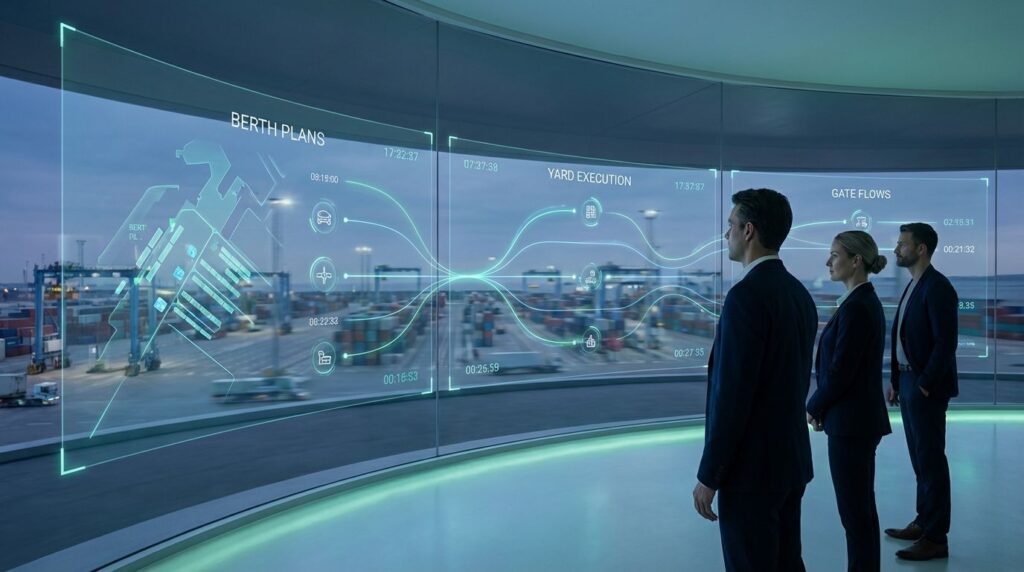
You can expect smart ports and terminals to become software-led, data-sharing networks where berth plans, yard execution, gate flows, and hinterland moves synchronize in near real time. The near-term winners will be the operators that standardize data exchange, harden systems against outages, and electrify equipment without breaking service levels.
This article maps where smart ports are headed, what changes you will feel first on the dock and at the gate, and how to prioritize technology without creating “integration debt.” You will also get practical decision points on regulations, automation, cybersecurity, and energy transition, written for people who run terminals, manage port calls, lead logistics operations, or buy capacity from ports.
What Is A Smart Port Or Smart Terminal, And What Changes First?
A smart port is not a crane that drives itself, it is a port that runs on shared, trusted operational data. You get connected visibility across vessel arrival, berth assignment, yard inventory, equipment availability, truck appointments, rail windows, and customs or authority clearances. When that data moves in one direction, from ships and carriers into port systems, you still get delays, just with better dashboards. When the data moves both ways, with consistent timestamps and commitments, you start cutting idle time that nobody gets paid for.
The first change you will notice is that administrative friction drops before physical operations change. Manual emails, repetitive submissions to multiple agencies, and “call the planner” workflows start to disappear when single-window reporting and standardized datasets are enforced. The International Maritime Organization requirement for a Maritime Single Window, mandatory since January 1, 2024, pushes ports and governments toward centralized digital submission and reuse of port-call data, which shifts smart-port adoption from “nice to have” to “you must comply.”
Operationally, early gains show up in predictability. Berth windows stabilize because ETAs, service windows, and clearance steps become easier to reconcile. Yard teams feel the difference when discharge profiles arrive earlier and in cleaner formats, which improves stow planning, rehandles, and labor calls. Gate teams feel it when appointment systems stop being “advice” and start being integrated with actual container availability, holds, and chassis or stack positions.
That sequence matters for your investment plan. If the port community still relies on duplicated data entry, you can add automation and still run into the same delays, just at higher cost. A mature smart terminal starts with data discipline, then adds machine control and advanced optimization once the information flow is reliable enough to let automation run safely and profitably.
How Does The Maritime Single Window Mandate Change Port Call Data, Clearance, And Planning?
The Maritime Single Window requirement changes your port call from a patchwork of forms into a governed data exchange. Public authorities must support electronic submission through one centralized platform, and the operating principle is “submit once, reuse as much as possible.” That concept sounds administrative, yet it directly impacts operations because vessel clearance steps determine when cargo can be discharged, moved, or released, and clearance delays often masquerade as yard congestion.
From an execution standpoint, you should treat MSW readiness like a production system cutover, not an IT milestone. A rushed go-live creates workarounds, and workarounds become the new standard. When submissions fail, the ship does not stop coming, trucks do not stop arriving, and your teams fall back to spreadsheets and ad hoc approvals. The result is not only delay, it is a measurable increase in transaction friction at gates, in documentation teams, and in exception handling inside the terminal operating system.
MSW also pressures vendors and ports to align with common datasets and reference models. The IMO ties MSW success to harmonization via compendiums and shared definitions so different stakeholders can exchange data without custom mapping for each port and agency. When you are selecting or upgrading a Port Community System, integrating your Terminal Operating System, or modernizing authority workflows, the question to ask is simple: will this system support standardized exchange without custom code that you will have to own for a decade?
The commercial impact is just as real. Cleaner, earlier port-call data supports better berth allocation, labor planning, and equipment deployment. You do not “win” by having more data, you win by having fewer contradictions in the data and fewer late changes that force expensive rework.
Which Technologies Will Define Smart Terminals By 2030?
By 2030, smart terminals will be defined by the stack that reliably links planning to execution. That stack is usually a Terminal Operating System integrated with appointment and rail modules, IoT-based visibility, analytics for optimization, and automation control for equipment and gates. Many ports will also rely on private wireless networks to keep latency low and coverage consistent across yards, berths, and maintenance areas.
IoT becomes valuable when it reduces uncertainty that drives wasted moves. Asset tags, machine telemetry, yard sensors, and computer vision can cut unproductive time by improving location accuracy and status verification. Industry commentary and market forecasts keep pointing to IoT-driven visibility and analytics as major drivers of change in port operations from 2025 onward, tied to faster decision cycles and more automation-ready operations. The practical takeaway is to prioritize IoT where it closes a control loop, not where it only creates a reporting feed.
AI in terminals will be less about “autonomous decisions” and more about decision support you can trust. You will see AI scheduling assistance for crane dispatching, yard crane sequencing, and resource allocation across peaks. You will also see AI used for exception prediction, container availability forecasting, and risk scoring for holds and inspection delays, all of which improve gate and rail reliability. If AI does not change the plan you execute, it stays a pilot.
Digital twin capabilities will keep spreading, mainly for change control. When you need to redesign a yard, add electric charging infrastructure, or reconfigure stack blocks for a new service, simulation reduces the risk of moving into a new operating mode blindly. The business case is avoiding disruption, not “cool visualization.”
Which Ports Are Leading In Automation And Integrated Control Systems?
Leading ports combine automation with centralized control and operational governance. Automation without governance becomes brittle, since small data errors can stop a machine-controlled workflow. Governance without automation still helps, yet it leaves productivity and energy efficiency on the table. The ports that stand out tend to do three things well: standardize data exchange, centralize operational control, and design for scalable electrification.
DP World’s published update on Jebel Ali Container Terminal 3 is a clear example of the “control system first” mindset. DP World reported completing implementation of its locally developed ZODIAC terminal operating system in CT3, describing remote control capabilities and positioning the system toward high automation, including integration across terminal facilities and assets. When you read claims like “100% automation,” treat them as a target state tied to a specific operating model, equipment set, and integration maturity. The lesson worth taking is that automation outcomes are driven by orchestration quality, not by buying isolated machines.
Electrification is now part of what makes a port “smart” because it changes how you plan shifts, maintenance, and yard circulation. DP World also reported expanding electric freight operations at Jebel Ali in partnership with Einride, highlighting that terminals are starting to treat energy and equipment strategy as one program rather than two separate initiatives. When electrification is real, you design charging and duty cycles into dispatch rules, and your TOS planning logic must reflect that operational constraint.
In North America, leadership looks different because the biggest wins often come from port community data coordination more than from full greenfield automation. The Port of Los Angeles’ Port Optimizer received an $8 million grant announced on July 16, 2024 to accelerate enhancements and interoperability across California ports, including appointment and mobile access elements tied to supply chain visibility. For operators, the message is direct: integrated data products that connect cargo status, appointments, and release conditions are productivity tools, not PR projects.
Will Smart Ports Reduce Congestion And Delays Or Move Bottlenecks Elsewhere?
Smart ports reduce congestion when they manage the entire call and the entire handoff chain. If you optimize berth plans but ignore truck arrival patterns, queues shift to the gate. If you optimize the gate but ignore empty return rules, the queue shows up at off-dock yards. If you digitize clearance but keep container availability logic disconnected from holds and inspections, you produce “appointments for boxes that cannot move,” which damages trust with drayage and BCOs.
Data sharing is the unlock, yet only if the shared data becomes operational commitments. UN trade and development commentary has emphasized that digital data sharing remains underused across maritime transport chains, and the missed opportunity is collaborative planning across actors, not just internal optimization by one node. If you want fewer bottlenecks, you need common definitions for ETA, ATA, planned start, planned completion, and release status, plus a discipline for updating those values when reality changes.
Congestion reduction also depends on how you manage exceptions. A smart terminal does not pretend exceptions go away, it processes them faster. That means automated alerts for holds, late vessel schedule changes, equipment downtime, and weather-driven work stoppages, plus decision rules that trigger re-plans early enough to avoid surprise peaks. You get the most durable gains when truck appointments, rail planning, and yard strategy operate off the same “source of truth,” not three separate versions of container reality.
Expect smart-port programs to be judged less by peak moves per hour and more by end-to-end reliability. Shippers measure cutoffs, last free day exposure, and dwell. Truckers measure turn times and appointment integrity. Rail measures on-time availability and predictable cut patterns. Smart ports will win when those metrics improve together, not when one metric improves at the expense of the others.
What Are The Biggest Risks When Terminals Go Fully Digital?
Your biggest risks are not theoretical. When a terminal becomes software-led, a system outage can stop physical flow faster than a mechanical failure, since every move depends on transactions, instructions, and authorizations. Cybersecurity becomes operational continuity, and continuity becomes customer trust. If you cannot execute during a disruption, your service contracts and your reputation absorb the cost.
The industry has a well-known proof point. A.P. Moller-Maersk disclosed that the NotPetya cyberattack was expected to impact results by USD 200–300 million and disrupted operations, affecting parts of Maersk Line, APM Terminals, and Damco. This is not old history, it is a reminder that ports and terminals sit inside a global software supply chain, and a compromise upstream can become a stoppage on your yard in hours.
Resilience failures are not only cyber. Hardware failures, network outages, identity management errors, and botched upgrades can break gates and halt releases. When the TOS cannot transact, your yard may still physically move containers, yet you lose track of inventory integrity and create a reconciliation storm that damages productivity for days. The smarter your port becomes, the more you must invest in redundant connectivity, segmented networks, tested recovery playbooks, and disciplined change control.
Interoperability risk also grows with digitization. Point-to-point integrations multiply until you cannot change one system without breaking three others. The MSW push toward standardization is partly a response to this risk, since shared datasets reduce bespoke mapping and reduce fragile interfaces. If the technology roadmap does not include rationalizing interfaces, you are building future outages into today’s project plan.
How Should You Plan Cybersecurity, Resilience, And Operational Continuity For Smart Terminals?
You should run cybersecurity and continuity as part of terminal operations, not as a back-office discipline. Start by classifying systems by operational criticality: TOS core, gate systems, equipment control, identity and access, EDI and community platforms, billing and release workflows. Then align recovery objectives with how the terminal actually runs. A four-hour outage tolerance sounds acceptable in a meeting, until it lands on a vessel cutoff day and turns into a yard jam plus detention exposure.
Segmentation is the baseline. Equipment control networks, operational technology, and corporate IT cannot share a flat network. Access control must assume that credentials will be targeted, since ports are high-value nodes and often include many third parties. If remote operations centers control cranes or AGVs, remote access tooling must be designed as critical infrastructure. Your vendor requirements should include security patch practices, logging, incident response cooperation, and clarity on who owns what in a shared responsibility model.
Operational continuity also means rehearsals. Disaster recovery tests that only restore servers but do not validate end-to-end transaction flows do not protect you. You need to prove you can: register a truck, validate an appointment, release a container, dispatch equipment, record a move, and send visibility to stakeholders, all under degraded conditions. That is the difference between “IT recovered” and “the terminal recovered.”
Once those basics are in place, smart-port technology becomes safer to scale. If you skip them, every new integration increases blast radius. Digital maturity without resilience maturity produces a terminal that looks advanced until it is under stress, then it fails loudly.
How Do You Make Electrification And Decarbonization Operationally Real Inside The Terminal?
Electrification becomes real when it changes how you dispatch equipment and plan yard flow. Electric yard tractors, electric drayage programs, battery-electric handling equipment, and charging infrastructure create operational constraints that must be scheduled. A terminal that treats electrification as a sustainability slide deck will run into missed moves, charging conflicts, and equipment availability swings. A terminal that treats electrification as operations will tie energy state into the TOS and maintenance planning.
Start with duty-cycle mapping. Identify which assets run predictable loops and which run irregular peaks. Predictable loops electrify first because you can plan charging windows and manage range risk. Irregular peaks can electrify later or require hybrid planning until charging coverage and operational discipline mature. You also need to quantify power availability at the terminal, since grid constraints can cap how quickly you can scale charging, even when equipment budgets are approved.
Procurement must include infrastructure, not only vehicles. Charging locations affect yard circulation, which affects congestion and safety. Electrical upgrades affect downtime windows and construction impacts. Software changes affect dispatch rules and KPI interpretation. When electric programs are built as an integrated program, productivity and emissions goals can move together instead of trading off.
Ports that align electrification with data platforms gain a real advantage. When you can measure idling, turn time variability, and energy use by process step, you can manage both cost and emissions with the same operational levers. That is where smart terminals separate from “digitized paperwork.”
What Will Adoption Look Like For Smaller Ports And Developing Regions?
Adoption will be uneven, and you should plan for a world where your network includes leaders and laggards at the same time. Large hubs can finance automation and data platforms, yet smaller ports often need targeted capacity building, shared tools, and phased digitalization plans. When those ports lack resources, they may comply with mandates at a minimal level but still struggle with integration quality, staff training, and resilience practices.
International capacity-building activity highlights that port digitalization is being treated as a resilience priority, not just modernization. A UN-hosted workshop on port digitalization and resilience for small ports in the Asia-Pacific region in December 2025 signals continued institutional focus on closing the readiness gap. For terminal operators and shipping lines, this matters because weak nodes create schedule variability and documentation friction that reverberates across services.
You should also expect blended solutions. Smaller ports may use shared MSW or national platforms, lighter-weight community systems, and modular upgrades rather than full “rip and replace” projects. This can work well when standards are enforced and vendors support interoperable exchange, and it fails when each stakeholder insists on custom formats and bespoke interfaces.
The practical move is to design your own systems to tolerate variability. Build connectors that support standard datasets, support manual fallback without losing auditability, and maintain disciplined exception handling. A smart terminal is not only fast in perfect conditions, it is stable when upstream data quality varies.
How Do You Build A Smart-Port Roadmap That Delivers ROI Without Integration Debt?
A smart-port roadmap succeeds when you sequence projects by operational dependency. Start with the data foundations you need for planning and clearance, then modernize execution systems, then scale automation where it will not be forced to guess. If you reverse that order, you end up automating around bad data and creating expensive workarounds that become permanent.
Define the operating outcomes in operational terms: berth plan stability, truck turn time, yard rehandle rate, equipment utilization, dwell distribution, and exception cycle time. Then map each outcome to the system capability that controls it: appointment integrity requires real-time availability and hold status, rail predictability requires synchronized cut plans, gate reliability requires identity and billing clarity. You can attach accountability when each KPI has an owning process and a controlling system.
Integration debt is your silent cost center. Every custom interface creates future testing and upgrade complexity, and every “temporary mapping” becomes a permanent dependency. Use standardized data models where possible, rationalize interfaces on a schedule, and refuse “one-off” integrations that solve a single customer request but create long-term fragility. The MSW direction toward standard datasets provides leverage for this discipline, since it gives you a compliance-backed reason to standardize.
Measure value continuously. If the program cannot show better appointment reliability, better yard execution, or fewer manual exceptions within a quarter or two after deployment, the issue is rarely the technology alone. It is usually process ownership, training, and data governance. Fix those fast, or the smartest system in the world becomes an expensive reporting tool.
What Is A Smart Port?
- Real-time shared data for port calls, yard, and gates
- Automation where data is reliable
- Resilience built into systems and operations
Make Your Port Ready For The Next Operating Standard
Smart ports and terminals are moving toward standardized digital reporting, interoperable data exchange, and control systems that tie planning directly to execution. If you want results that show up in turn times and berth reliability, start with data governance and MSW readiness, then scale visibility and optimization, then automate where the operating model can support it. Treat cybersecurity and continuity as operations, not IT, because outages and attacks stop cargo as fast as any mechanical failure. Align electrification with dispatch rules, charging design, and measurable performance so energy transition does not become a productivity penalty. Build the roadmap in the order your terminal actually runs, and smart-port investment will translate into dependable throughput and customer confidence.
References
- IMO: Maritime Single Window (MSW) Mandatory As From 2024
- UNCTAD: Digital Data Sharing In Maritime Transport Chains
- GlobeNewswire: IoT Technologies Set To Revolutionize Port Operations From 2025
- DP World: ZODIAC System Implementation In Jebel Ali Port CT3 (March 1, 2021)
- DP World: Electric Freight Operations At Jebel Ali With Einride
- Port of Los Angeles: Port Optimizer Awarded $8 Million GO-Biz Grant (July 16, 2024)
- CNBC: Maersk Says NotPetya Cyberattack Could Cost $300 Million (Aug 16, 2017)
- UN Indico: Capacity-Building Workshop On Port Digitalization And Resilience Of Small Ports (Dec 3–4, 2025)


Benjamin Gordon is Managing Partner at BG Strategic Advisors and Cambridge Capital, specializing in supply chain and logistics investment banking. With 20+ years of experience, he founded 3PLex (sold to Maersk), previously led strategy at Mercer, and chairs the BGSA Supply Chain CEO conference (MBA, Harvard; BA, Yale).